https://youtube.com/shorts/ZzTAvxRd-fI
① Location
• Centric medullary lesion
• Long bone diaphysis
• Smooth cortex (even when thinned)
② Signal (non-specific on purpose)
• T1WI: iso- to low signal
• T2WI: variable
• Often heterogeneous
③ Secondary changes (very common)
• Cystic degeneration
• Hemorrhage
• Fluid–fluid levels (ABC-like)
④ Contrast enhancement (this matters)
• Mild, diffuse, heterogeneous
• No nodular or mass-like enhancement
• Cystic areas = non-enhancing
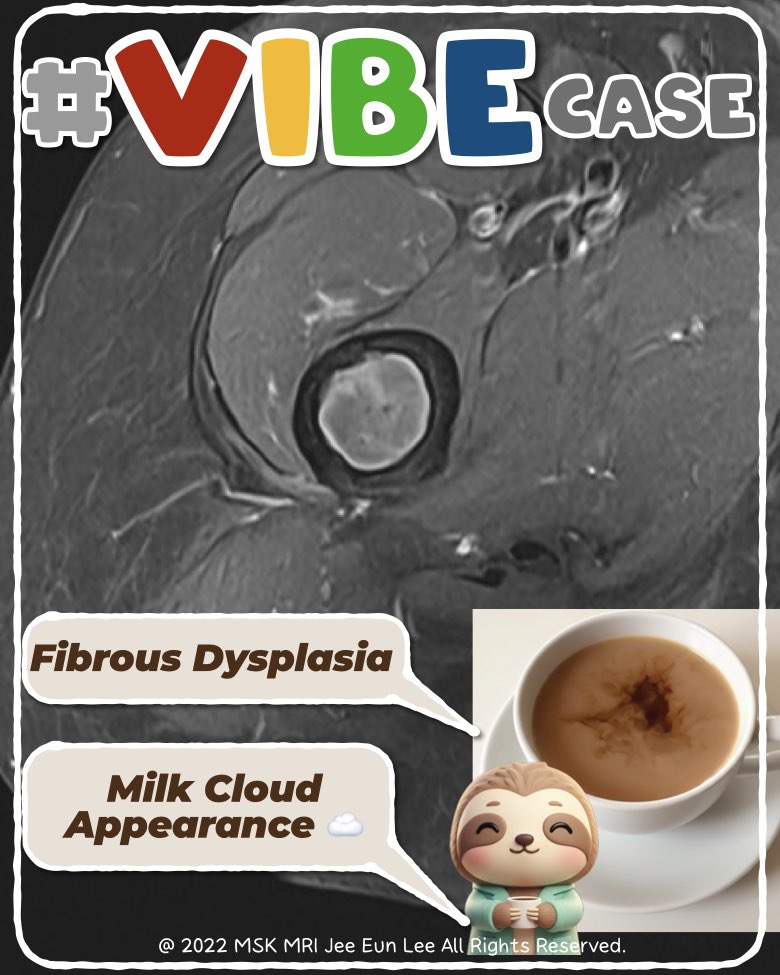
⑤ Key clue: Milk cloud appearance ☁️
• Patchy, ill-defined, cloudy enhancement
• Spreads within a low-signal matrix
• Reflects loose fibro-osseous stroma
• Not a solid hypervascular tumor
If enhancement looks “cloudy,” not “solid” → think FD.
#FibrousDysplasia, #BoneMRI, #MSKRadiology, #MilkCloudAppearance, #MRIPatterns, #ContrastMRI, #BoneLesions, #RadiologyPearls, #MusculoskeletalImaging, #RadiologyEducation, #Vibecase
Visualizing MSK Radiology: A Practical Guide to Radiology Mastery
© 2022 MSK MRI Jee Eun Lee All Rights Reserved.
No unauthorized reproduction, redistribution, or use for AI training.
'✅ Dr. Slothic Notes' 카테고리의 다른 글
| 📌 Ankle Coronal MRI Essentials (0) | 2025.12.14 |
|---|---|
| 📌 Scapholunate Ligament Tear in Distal Radius Fractures (0) | 2025.12.13 |
| 📌 Fibrous Dysplasia on Radiograph & CT — Classic Features to Recognize (0) | 2025.12.12 |
| 📌 A Quick Guide to Understanding the Dorsal, Volar, and Proximal Scapholunate Ligament (0) | 2025.12.11 |
| 📌 Scapholunate Ligament: Gross Anatomy and Key MRI Distinctions (0) | 2025.12.10 |