https://youtube.com/shorts/M18GXT25oGM
Normal MRI Appearance
- Nerve roots are thin, freely floating, and evenly distributed within the thecal sac.
- Sagittal T2: smooth, symmetric fanning of nerve roots.
- Axial T2: multiple discrete nerve root dots surrounded by bright cerebrospinal fluid.
Abnormal Findings in Chronic Adhesive Arachnoiditis
1. Nerve Root Morphology
- Nerve roots become moderately thickened due to chronic inflammatory–fibrotic change.
2. Abnormal Distribution
- Loss of normal fanning.
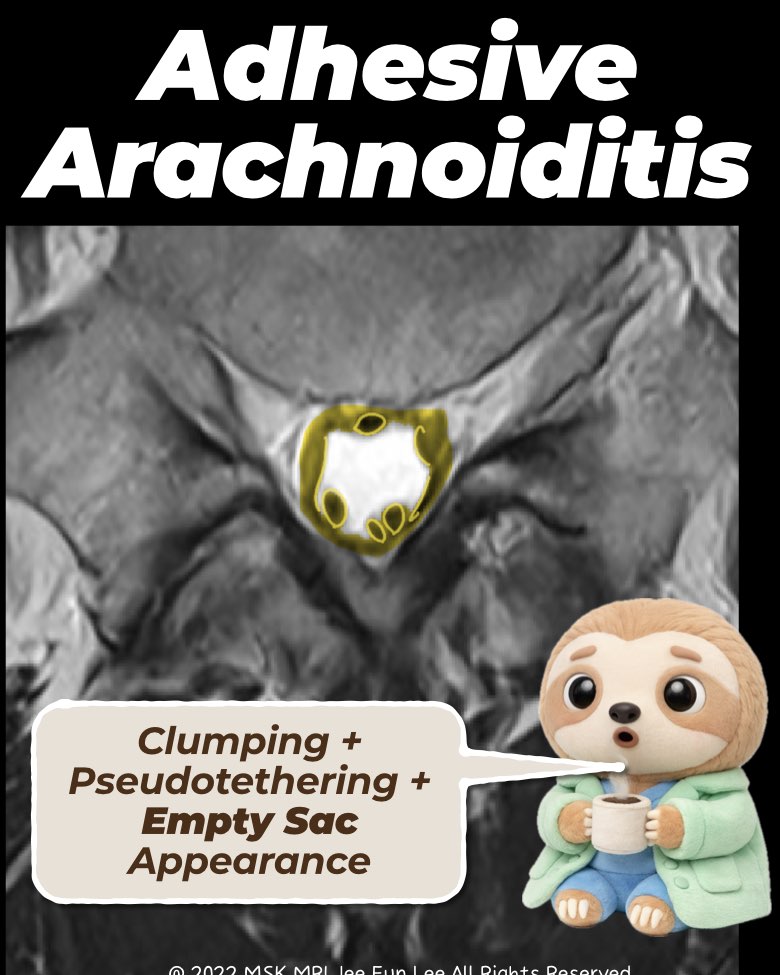
- Nerve roots show clumping rather than free dispersion.
3. Axial Imaging Pattern
- Clumping of nerve roots with pseudotethering.
- Roots appear tethered, reflecting fibrotic adhesion, not true mechanical tethering.
4. Sagittal Imaging Pattern
- Absence of normal root striations.
- Progressive peripheral adherence of nerve roots to the arachnoid.
5. Key Diagnostic Sign
- Central thecal sac appears empty.
- This represents the empty thecal sac sign—
fluid remains, but central nerve roots are absent.
Imaging Interpretation
- This pattern reflects chronic, often “burnt-out” arachnoiditis.
- Enhancement is usually minimal or absent.
- Recognition of this morphology is critical to avoid misdiagnosis and hazardous intervention.
Key Takeaway
- Thickened nerve roots
- Loss of fanning
- Clumping with pseudotethering
- Empty thecal sac appearance
→ Think chronic adhesive arachnoiditis.
#ChronicAdhesiveArachnoiditis, #EmptyThecalSacSign, #NerveRootClumping, #Pseudotethering, #SpineMRI, #Neuroradiology, #MRIpatternRecognition, #RadiologyEducation, #MSKRadiology, #AxialT2, #Vibecase
Visualizing MSK Radiology: A Practical Guide to Radiology Mastery
© 2022 MSK MRI Jee Eun Lee. All Rights Reserved.
No unauthorized reproduction, redistribution, or use for AI training.



'✅ Dr. Slothic Notes' 카테고리의 다른 글
| 📌 Not Every Bright Lesion Is a Synovial Cyst (0) | 2026.01.10 |
|---|---|
| 📌 Facet Synovial Cyst (0) | 2026.01.10 |
| 📌Synovial Chondromatosis of the Subacromial–Subdeltoid Bursa (0) | 2026.01.07 |
| 📌 Lipoma Arborescens of the Subacromial–Subdeltoid Bursa (0) | 2026.01.07 |
| 📌 Subacromial Extrinsic Impingement (0) | 2026.01.06 |