https://youtube.com/shorts/Q4ZsRppW40U
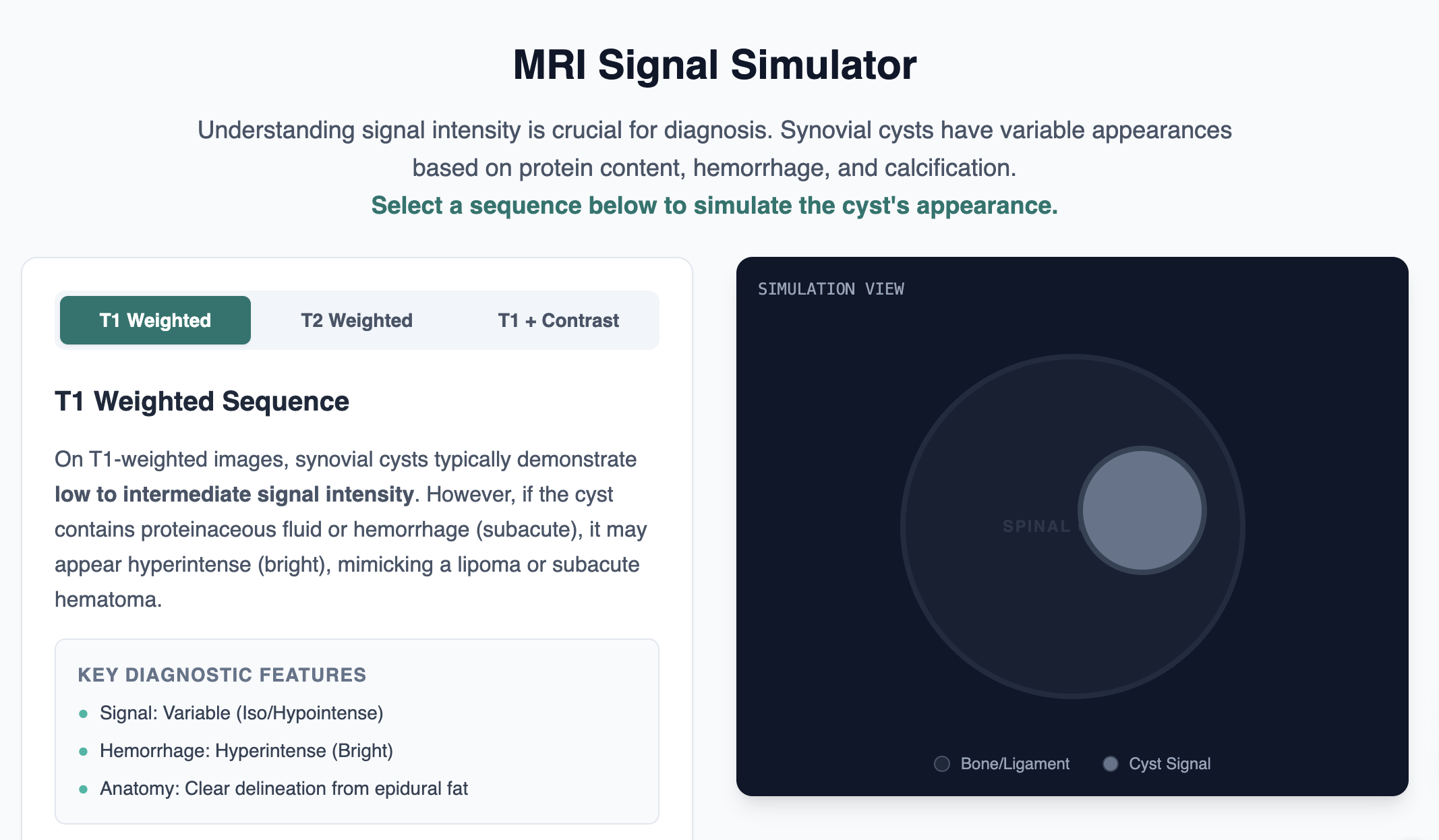
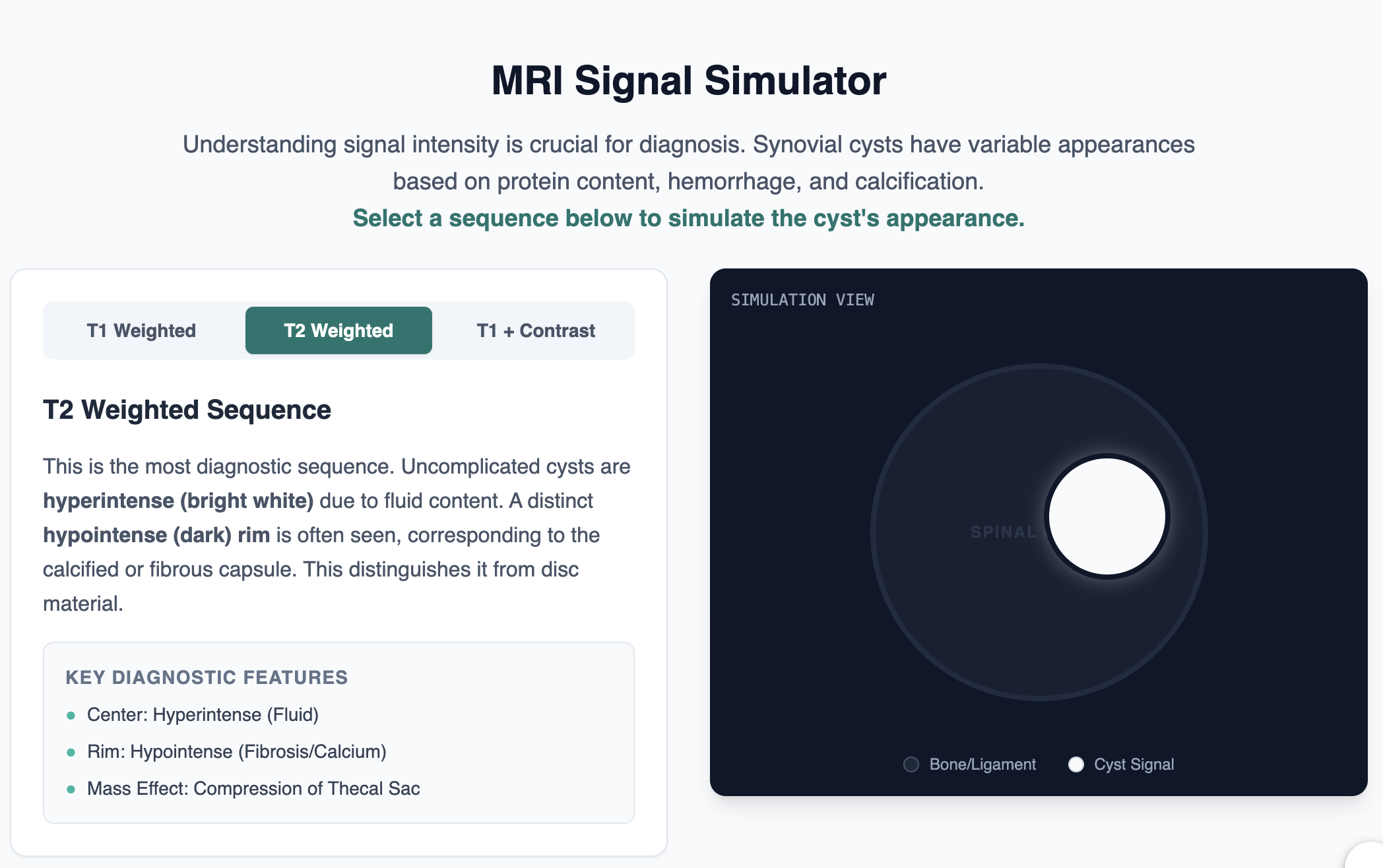
Although synovial cysts are cystic lesions, their MRI signal frequently deviates from a “simple cyst” pattern due to variable internal contents.
MRI Signal Variations in Synovial Cysts — Mechanism-Based Explanation
1. Simple (Serous) Synovial Cyst
- T1WI: Low
- T2WI: High
- Low protein concentration
- Most favorable for percutaneous rupture
2. High Protein Content / Viscous Synovial Fluid
- Chronic synovitis → increased protein concentration
- T1WI: Isointense to mildly hyperintense
- T2WI: Signal intensity is inversely proportional to protein content
- No hemorrhagic ancillary signs
3. Hemorrhagic Synovial Cyst
- Caused by intracystic bleeding from vascular synovial lining
- Subacute stage (methemoglobin)
- Ancillary clues:
- Important because it can mimic a solid mass
4. Vacuum Phenomenon (Gas-Containing Synovial Cyst)
- Nitrogen gas enters cyst from degenerated facet joint
- T1WI: Low signal (signal void)
- T2WI: Low signal
- GRE: Blooming artifact
- Never causes T1/T2 hyperintensity
5. Calcified Synovial Cyst
- Long-standing degeneration and chronic inflammation
- T1WI: Low
- T2WI: Low
- Best detected on CT
- Often resistant to percutaneous rupture
Take-Home Message
Synovial cysts are rarely “simple cysts.” Their MRI appearance reflects internal content—protein, blood, gas, or calcification—and must be interpreted in an anatomic and clinical context.
#SpineMRI #LumbarSpine #BackPain #Radiculopathy #MRI
#Radiology #MSKRadiology #SpineRadiology
#SynovialCyst #FacetJoint #SpinalStenosis
#RadiologyEducation #CaseBasedLearning #Vibecase
Visualizing MSK Radiology: A Practical Guide to Radiology Mastery
© 2022 MSK MRI Jee Eun Lee. All Rights Reserved.
No unauthorized reproduction, redistribution, or use for AI training.


'✅ Dr. Slothic Notes' 카테고리의 다른 글
| 📌 Plantar Fasciitis and Haglund’s Syndrome (0) | 2026.01.14 |
|---|---|
| 📌 CPPD Wrist on CT_ Diagnosis, TFCC Tear Prediction, and Ligament Anatomy (0) | 2026.01.13 |
| 📌 Facet Synovial Cyst (0) | 2026.01.10 |
| 📌 When Nerve Roots Stop Floating. (0) | 2026.01.08 |
| 📌Synovial Chondromatosis of the Subacromial–Subdeltoid Bursa (0) | 2026.01.07 |