https://youtube.com/shorts/w39HxJSCbXc
An imaging pitfall radiologists should not miss
Recurrent pain after tarsal tunnel release is often attributed to residual or recurrent entrapment or a new space-occupying lesion.
However, imaging occasionally reveals a different and easily overlooked entity:
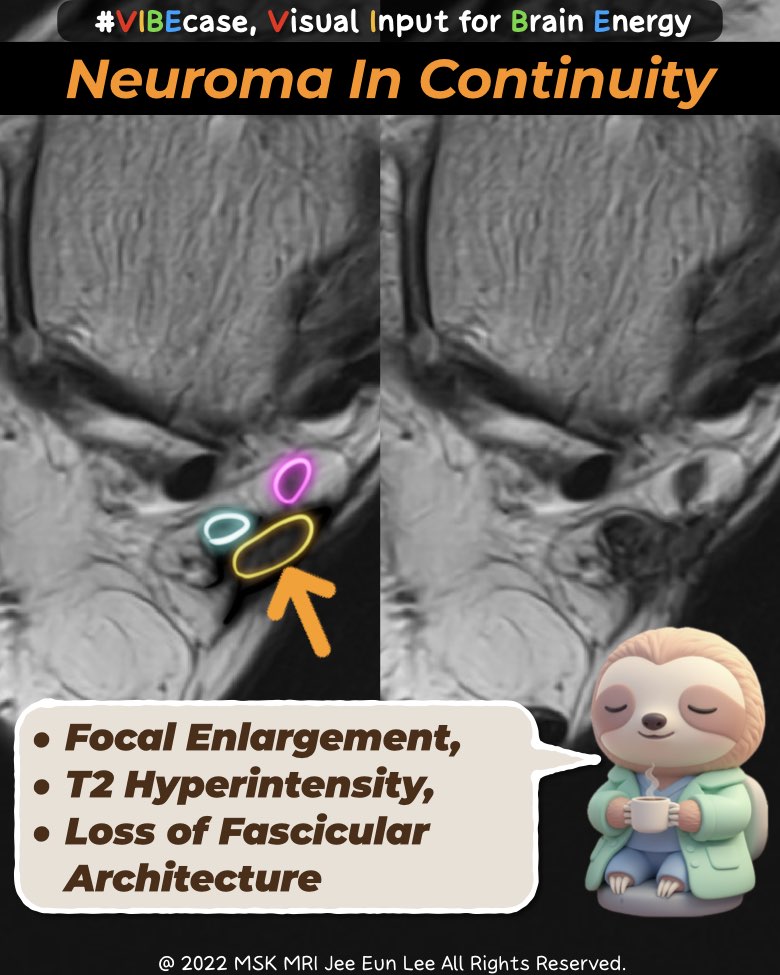
neuroma in continuity (NIC) of the posterior tibial nerve.
Unlike an end-bulb neuroma, NIC occurs after high-grade partial nerve injury (Sunderland grade III–IV), where the epineurium remains intact but the internal fascicles are severely disrupted by scarring and disorganized regeneration.
This distinction is critical, because preserved continuity implies potential residual function, directly influencing surgical strategy.
Why the tarsal tunnel matters
The tarsal tunnel is a rigid fibro-osseous space.
After surgery, perineural fibrosis and tethering may limit normal nerve mobility.
Chronic traction within this confined tunnel leads to progressive intraneural damage, while the scarred nerve segment itself becomes a secondary space-occupying lesion, further compressing adjacent viable fascicles.
Key MRI findings
On high-resolution MRI, NIC should be suspected when the posterior tibial nerve demonstrates:
- Fusiform focal enlargement within the tunnel
- Increased T2/STIR signal reflecting intrinsic nerve pathology
- Loss of the normal fascicular pattern with internal heterogeneity
- Preserved proximal and distal continuity of the nerve
- Associated denervation changes in plantar muscles, supporting axonal injury and functional impairment
These findings help differentiate NIC from:
- Simple postoperative fibrosis
- Recurrent ganglion or varicosity
- Generalized tarsal tunnel syndrome without focal intraneural pathology
Role of ultrasound
High-resolution ultrasound complements MRI by clearly demonstrating:
- A hypoechoic fusiform nerve lesion
- Increased cross-sectional area
- Loss of normal fascicular architecture, while maintaining continuity
Correlation with electrodiagnostic studies is essential to assess functional viability versus non-functional scar burden, guiding the decision toward neurolysis, functional salvage, or reconstruction rather than simple excision.
Take-home message for radiologists
Not every recurrent postoperative tarsal tunnel symptom is “just persistent entrapment.”
When imaging shows a continuous but structurally abnormal nerve, consider neuroma in continuity—
a diagnosis that shifts management from treating a mass to understanding nerve biology and function.
#NeuromaInContinuity, #PosteriorTibialNerve, #TarsalTunnelSyndrome, #PeripheralNerveMRI, #MSKRadiology, #FootAnkleImaging, #PostoperativeMRI, #NerveEntrapment, #RadiologyPearls, #DrSlothic, #Vibecase
Visualizing MSK Radiology: A Practical Guide to Radiology Mastery
© 2022 MSK MRI Jee Eun Lee All Rights Reserved.
No unauthorized reproduction, redistribution, or use for AI training.

'✅ Dr. Slothic Notes' 카테고리의 다른 글
| 📌 Two Heads, Two Functions: Understanding the Distal Biceps on MRI (0) | 2025.12.20 |
|---|---|
| 📌 Not a Bucket-Handle Tear: Think Oblique Meniscomeniscal Ligament (0) | 2025.12.20 |
| 📌 Tibial Nerve Anatomy in the Tarsal Tunnel (0) | 2025.12.15 |
| 📌 Ankle Coronal MRI Essentials (0) | 2025.12.14 |
| 📌 Scapholunate Ligament Tear in Distal Radius Fractures (0) | 2025.12.13 |